A Revolutionary Treatment for Keratoconus and Corneal Ectasia

Patients are referred to us for corneal cross-linking in Chicago from throughout the Midwest. CXL has transformed the treatment of corneal ectasia, an abnormal steepening and thinning of the cornea. The cornea is the transparent "window" of the eye, and it plays a major role in how clearly you see. In conditions such as keratoconus and post-LASIK ectasia, the cornea gradually loses its normal shape, becoming thin and cone-shaped. Left undetected or untreated, these changes can progress over months and years, leading to frequent prescription changes and, in some cases, permanent vision loss. Cross-linking was developed to halt that progression. Rather than correcting vision the way LASIK or PRK does, CXL strengthens the cornea itself so the underlying condition is less likely to advance.

Learn About FDA-Approved Epi-On CXL for Keratoconus →

woman with curly hair looking in the mirror

Prevent Vision Loss

These changes in the cornea can continue to progress over months and years leading to frequent changes in prescription and, if undetected or untreated, may result in permanently decreased vision.  Often at a late stage, the only remedy is corneal transplantation, which is a major surgical procedure.

Fortunately, with early detection and CXL treatment, many patients may be able to maintain good vision and prevent the need for corneal transplant surgery.

CXL is an in-office procedure in which Riboflavin (Vitamin B2) and Ultraviolet (UV) light are used to create cross-links between the collagen fibers of the cornea, making it more rigid and preventing further changes from occurring.

How Does Corneal Cross-Linking Prevent Vision Loss?

CXL works by adding new bonds, or "cross-links," between the collagen fibers that give the cornea its strength and shape. Riboflavin (Vitamin B2) is applied to the cornea, then activated with ultraviolet (UV) light. Together, they trigger a reaction that makes the cornea more rigid and more stable.

With early detection and timely treatment, many patients are able to preserve good vision and avoid the need for a corneal transplant, which is a far more involved surgical procedure. Fortunately, decades of published research support the high success rate of cross-linking in slowing or stopping progression.

It is important to understand the procedure's goal. Unlike refractive surgery, CXL is designed to prevent further vision loss rather than to sharpen vision on its own. Most patients still need glasses or contact lenses afterward, though many find their tolerance for specialty keratoconus lenses improves significantly once the cornea is stabilized.

Banner media

What Are the Two Types of Corneal Cross-Linking?

There are two approaches to cross-linking, which differ mainly in how riboflavin reaches the cornea. Our doctors offer both and will recommend the technique best matched to your eyes.

  • Epithelium-Off (Epi-Off) CXL: The thin outer layer of the cornea, called the epithelium, is gently removed so riboflavin can saturate the tissue before UV light is applied. This is the original FDA-approved method, approved in 2016, and it is clinically proven and effective.
  • Epithelium-On (Epi-On) CXL: The epithelium is left intact, and a specially formulated riboflavin solution penetrates the surface on its own. Because the cornea is never opened, recovery tends to be faster and more comfortable.

Each method has its place. Advanced or very thin corneas may still be best served by the epithelium-off technique, while many patients with progressive keratoconus are now strong candidates for the epithelium-on approach.

What to Expect With Epithelium-Off CXL

With the epi-off technique, both eyes are generally not treated on the same day. Because the surface layer is removed, a soft "bandage" contact lens is placed afterward for comfort and to support healing, and it is usually removed several days later once the surface has closed.

Vision is typically blurrier than usual during this healing window, which can last several weeks. Mild discomfort and light sensitivity are common in the first few days. While most patients never need more than one treatment, CXL can be repeated if necessary.

Background media

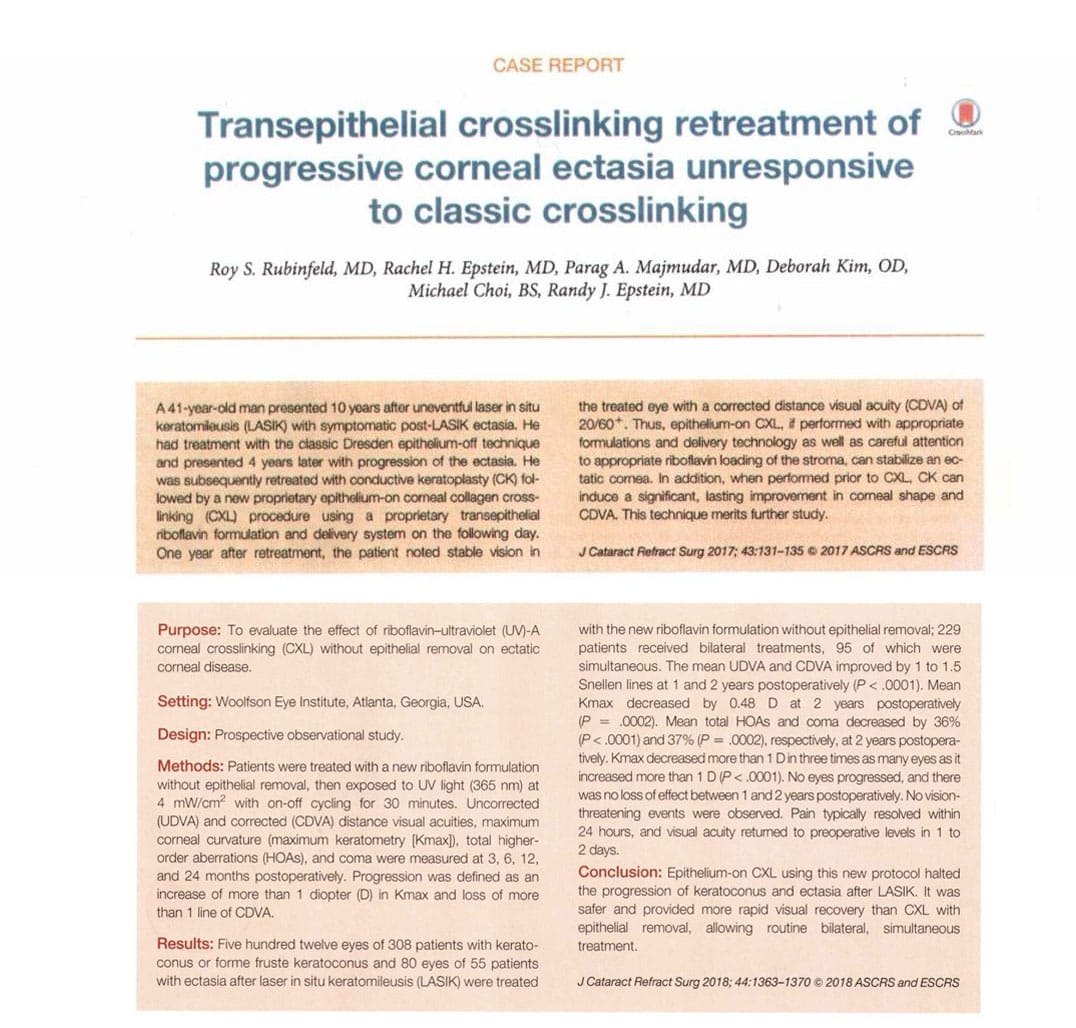
Chicago Cornea Consultants™ has participated in publications discussing Epithelium-ON CXL, which can be reviewed here:

case report

FDA-Approved Epi-On CXL With Epioxa

In October 2025, the FDA approved Epioxa™, developed by Glaukos, as the first and only epithelium-on corneal cross-linking therapy available in the United States. Chicago Cornea Consultants™ is proud to be among the first practices in Illinois to offer it to patients.

Epioxa is indicated for the treatment of keratoconus in adults and in pediatric patients 13 years and older. Instead of removing the epithelium, it uses an oxygen-enriched riboflavin formulation that penetrates the intact surface, then activates it with UV light in an oxygen-rich environment to strengthen the cornea.

Because the corneal surface stays intact, patients treated with Epi-On CXL may benefit from:

  • A shorter recovery and faster return to everyday activities
  • Significantly less discomfort during and after treatment
  • A reduced risk of infection, since the surface is never opened
  • A lower risk of corneal haze or scarring
  • The ability to treat both eyes on the same day

FDA approval of Epioxa was supported by two Phase 3, randomized, double-masked clinical trials. Treatment produced a clinically meaningful improvement in maximum corneal curvature (Kmax) at 12 months and was well tolerated. For many patients, this means returning to daily life within a day or two rather than waiting a week or more.

Our Experience With Epi-On Cross-Linking in Chicago

Epi-On CXL is not new territory for our team. Chicago Cornea Consultants™ participated in the CXL-USA clinical trial from 2010 to 2019, successfully performing epithelium-on cross-linking on more than 2,000 eyes with excellent results, one of the largest and longest-running investigational efforts of its kind in the country.

Our practice was also the first in the Chicago area to perform CXL, beginning in 2010, years ahead of the 2016 FDA approval of the standard epi-off procedure. Since then, our doctors have treated more than 3,000 eyes, more than any other practice in metro Chicago. When the FDA approved Epioxa, our team was already deeply familiar with the procedure, its outcomes, and the patients it is best suited to help.

Banner media

Am I a Candidate for Corneal Cross-Linking?

If you have been diagnosed with keratoconus or corneal ectasia, you may be a candidate for CXL. Candidates are typically those with documented evidence of corneal change and sufficient corneal thickness to undergo treatment safely.

Epi-On CXL may be an especially good fit for patients who are concerned about recovery time, who want both eyes treated in a single visit, or who are younger with progressive disease and want to act early. Not everyone with keratoconus is automatically a candidate, however, and the right technique depends on your individual exam.

A thorough evaluation at Chicago Cornea Consultants™, including corneal topography and thickness measurements, allows our doctors to determine whether Epi-On CXL, traditional Epi-Off CXL, or another approach is right for you.

Additional Corneal Procedures for Keratoconus

Cross-linking is often just one part of a larger treatment plan. In some cases, patients with keratoconus may benefit from additional corneal procedures to improve corneal shape and stability. Our doctors will determine which treatment options may be appropriate based on each patient's individual exam and needs.

Specialty contact lenses also play an important role for many patients, particularly once the cornea has been stabilized. Whatever your situation, our team will walk you through every option and build a plan tailored to your eyes and goals.

Banner media

When Is It Time for CXL?

The best time to consider cross-linking is early, before the cornea has steepened and scarred. Because keratoconus often progresses most rapidly in younger patients, prompt evaluation matters when a diagnosis is made or when a cornea appears to be changing.

If you have keratoconus or corneal ectasia, call any of our Chicago-area offices to schedule a consultation. Acting sooner gives our doctors the best opportunity to protect your vision.

Contact us media

Does Insurance Cover CXL Treatment?

Coverage for FDA-approved cross-linking is now widely available, as a growing number of commercial insurance carriers recognize the medical necessity of the procedure. The large majority of the commercially insured population has access to this potentially sight-protecting treatment.

Coverage details still vary by plan, so our team will help verify your benefits before treatment and explain any out-of-pocket costs up front.

Is Financing Available?

Convenient, affordable financing is available to help patients get the treatment they need before keratoconus or a similar condition progresses to a point where CXL is no longer an option.

Cost should never be the reason a treatable cornea goes untreated.

Financing With CareCredit

CareCredit® offers a payment plan that fits your individual needs and financial circumstances. If you have been postponing an ophthalmic procedure due to budget concerns, CareCredit® can help. Call our office for details.

Epi-On CXL and CXL Candidacy FAQs

What is the difference between Epi-On and Epi-Off CXL?

Is Epioxa FDA-approved?

Can both eyes be treated on the same day with Epi-On CXL?

Will cross-linking improve my vision?

Who is a candidate for Epi-On CXL?

How soon should I be evaluated?

What is the difference between Epi-On and Epi-Off CXL?

The main difference is the corneal surface. Epi-Off CXL removes the epithelium so riboflavin can soak in, while Epi-On CXL leaves it intact and uses a formulation that penetrates on its own. Epi-On generally means less discomfort and a faster recovery, though Epi-Off remains an excellent option for certain corneas.

Is Epioxa FDA-approved?

Yes. Epioxa received FDA approval in October 2025 and is the first and only epithelium-on corneal cross-linking therapy approved in the United States. It is indicated for keratoconus in adults and in patients 13 years and older.

Can both eyes be treated on the same day with Epi-On CXL?

In many cases, yes. Because the epithelium stays intact, Epi-On CXL can often be performed on both eyes in a single visit, with a recovery that is typically faster and more comfortable than the epithelium-off technique.

Will cross-linking improve my vision?

The primary goal of CXL is to halt progression, not to correct vision directly. Many patients do see improved comfort and tolerance with specialty contact lenses afterward, but most still rely on glasses or contacts for clear vision.

Who is a candidate for Epi-On CXL?

Patients with progressive keratoconus who have sufficient corneal thickness are often candidates. The only way to know for certain is a comprehensive evaluation, including corneal topography and thickness testing, with one of our doctors.

How soon should I be evaluated?

As soon as possible after a diagnosis or any sign of corneal change. Keratoconus can progress quickly in younger patients, and early treatment gives our team the best chance to preserve your vision.

See the Best With Chicago Cornea Consultants™

If you have been diagnosed with keratoconus, or you have been told your cornea is changing, the team at Chicago Cornea Consultants™ can evaluate your eyes and walk you through every option, including FDA-approved Epi-On CXL with Epioxa. During your visit, our doctors will review your corneal topography, measure thickness, assess the rate of progression, and recommend the approach best matched to your eyes and lifestyle.

With more than 15 years of cross-linking experience, more procedures performed than any practice in the Chicago area, and direct involvement in the clinical trials behind FDA approval, our team brings a depth of expertise that is difficult to match.

Request an Appointment | (800) 8-CORNEA

Contact us media
Accessibility: If you are vision-impaired or have some other impairment covered by the Americans with Disabilities Act or a similar law, and you wish to discuss potential accommodations related to using this website, please contact our Accessibility Manager at (847) 882-5900.
Contact Us